

Yaddith
Yaddith is the alien world on which Carter becomes entangled with the wizard Zkauba in Through the Gates of the Silver Key. Its many-sunned environment, extensive learning and interstellar travel offer precisely the wonders he sought, while its body and timescale make return to Earth an immense problem. The account presents a civilization under continual pressure from creatures beneath its surface.
5 min read · 856 words
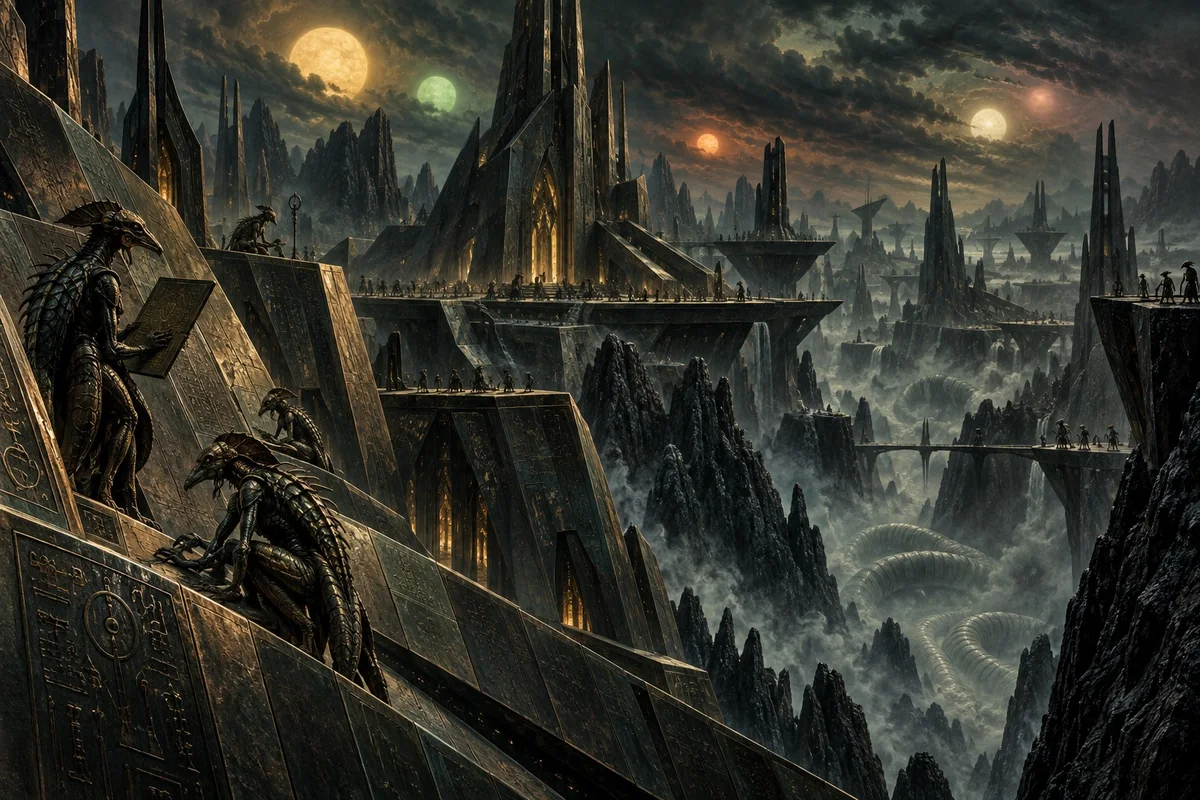
The dreamed world chosen by Carter
Carter has repeatedly dreamed of a world with five differently colored suns, dark crags, strange metal architecture and clawed inhabitants with snouts. Beyond the Ultimate Gate, he asks the informing Being to let him experience that world bodily.
Sources: [1]
The location is associated with an unfamiliar multiple-star system in a remote galaxy. The story does not supply a real astronomical identification or coordinates that can be mapped from the names of known stars.
The attraction is active contact with other worlds. Carter believes that this civilization is unusually well connected beyond itself and hopes to explore the routes that his dreams have only suggested.
Bodies and built environment
The inhabitants have articulated, partly scaled bodies described as broadly insect-like while still suggesting a distorted human outline. Their claws and snouts are important to Carter’s immediate recognition that he now belongs physically among them.
Zkauba’s movements include climbing a metal wall to enter his apartment. Tablets occupy a rack, and he sits on a prism to study. Such details give the civilization ordinary activities shaped by a different body, rather than presenting only a distant panorama of fantastic towers.
The human and alien viewpoints regard one another with disgust. The description therefore should not be read as proof that only Carter has an intelligible inner life. Zkauba experiences the human identity as an intrusion into his own established world.
Sources: [1]
Libraries, wizards and routes between worlds
Yaddith possesses accumulated knowledge of thousands of living and dead worlds. Carter participates in library study and consultations with learned minds, including the Arch-Ancient Buo. Zkauba’s prior experiences provide information that the human alone could never have acquired.
The civilization’s light-beam envelopes give access to worlds across twenty-eight galaxies. The narrative names several destinations but does not turn their mention into complete geographical descriptions. Travel through time also involves the key and other symbols known to the wizards.
Carter’s problem persists despite this abundance. The specific supplementary spell needed to restore his human form belongs to a tradition not duplicated by the available learning. A vast library does not guarantee that every missing piece of knowledge can be recovered locally.
Sources: [1]
The bholes below
Bholes occupy the tunnels beneath Yaddith. They are described as immense, pale and viscous, and Zkauba’s work includes spells intended to keep them in their burrows. The civilization therefore exists alongside an internal threat it must continually restrain.
When Carter changes the time-angle in preparation for departure, he reaches a future in which Yaddith is dead and the bholes have triumphed. The structure from which he began has vanished, leaving his vehicle suspended above the altered surface. A huge creature rises toward him before his protective measures allow escape.
The episode gives the planet a future that differs radically from the inhabited world of Zkauba’s daily life. It is not evidence that the civilization is already extinct in every scene of Carter’s earlier residence.
Sources: [1]
Long life and competing identities
Carter spends periods on Yaddith far longer than an ordinary human lifespan. The inhabitants live through prolonged cycles, and his account measures effort in unfamiliar units and repeated revolutions before describing thousands of terrestrial years of conscious experience.
During that time, Carter and Zkauba alternate in dominance. Carter studies the way home, while Zkauba tries to remove the intrusive human memories. The alien drug Carter eventually uses suppresses Zkauba but preserves access to his useful knowledge.
The story does not provide a precise total duration that can be converted into a complete dated chronology. It gives immense scale and several local measures, sufficient to show how different Carter’s subjective history becomes from the few years of absence recorded on Earth.
Sources: [1]
Preparing a body for another world
Carter’s escape requires more than a route across space. He prepares a durable travel envelope, suspended animation, protection against the bholes, gold, a disguise and adaptations to terrestrial biological and gravitational conditions.
The key can change the temporal position of the unchanged alien body, but it cannot restore the human one without the omitted spell. His chosen solution is therefore to carry Zkauba’s body to Earth and obtain the parchment there.
The destination is reached in 1930, but the problem of embodiment continues. Speech, food, appearance and the exhausted drug supply shape his life in Boston. The alien world remains present through the body and memories he has brought away.
Sources: [1]
How the frame qualifies the account
All this history reaches the estate conference through the apparent Swami, who ultimately declares himself Carter. Other participants cannot directly verify the planet, its libraries or the immense voyage.
The final scene supplies disturbing partial evidence and an unexplained disappearance, but the surviving witnesses acknowledge remaining doubts. No travel envelope is recovered in the later search near Arkham.
Yaddith is therefore fully described as a fictional setting within the visitor’s narrative, while the frame preserves the question of that narrative’s proof. A reliable synopsis can explain both levels instead of turning the conference into an uncontested scientific report.
Sources: [1]
Related music
The Key and the Gate is a dark metal retelling of The Dunwich Horror, following Wilbur Whateley’s doomed search for forbidden knowledge and the power of Yog-Sothoth.
References
- Through the Gates of the Silver Key — original text
The fictional narrative is evidence for what the story says, not proof of events in the real world.
At a glance
H. P. Lovecraft and E. Hoffmann Price
Through the Gates of the Silver Key
Five suns in the described system
Zkauba
Burrowing bholes
Light-beam envelopes
Dead world dominated by bholes
Not supplied