

Surama
Surama is the ancient, outwardly humanlike instructor who draws Dr. Alfred Schuyler Clarendon toward forbidden experiments in The Last Test. His learning links the physician’s laboratory to a concealed North African vault, an Atlantean past and an infection said to originate beyond Earth. The story reveals his bodily difference without identifying him as a member of any other named Mythos species.
6 min read · 1,077 words
Source and narrative position
Surama belongs to The Last Test, the 1928 published revision produced by H. P. Lovecraft from a story by Adolphe de Castro. His actions are described within that revision; the account here does not assume that every feature also occurs in the earlier A Sacrifice to Science.
He initially appears as an unsettling associate of a respected physician. The public controversy concerns Clarendon's management of a prison outbreak, while Surama remains largely within the secluded household and laboratory. Only the final confession explains why this apparently secondary figure matters to the entire crisis.
The distinction between his public role and concealed history is fundamental. Calling him simply a laboratory assistant understates his influence, while treating him as an omnipotent deity overstates what the narrative establishes.
Appearance and concealed anatomy
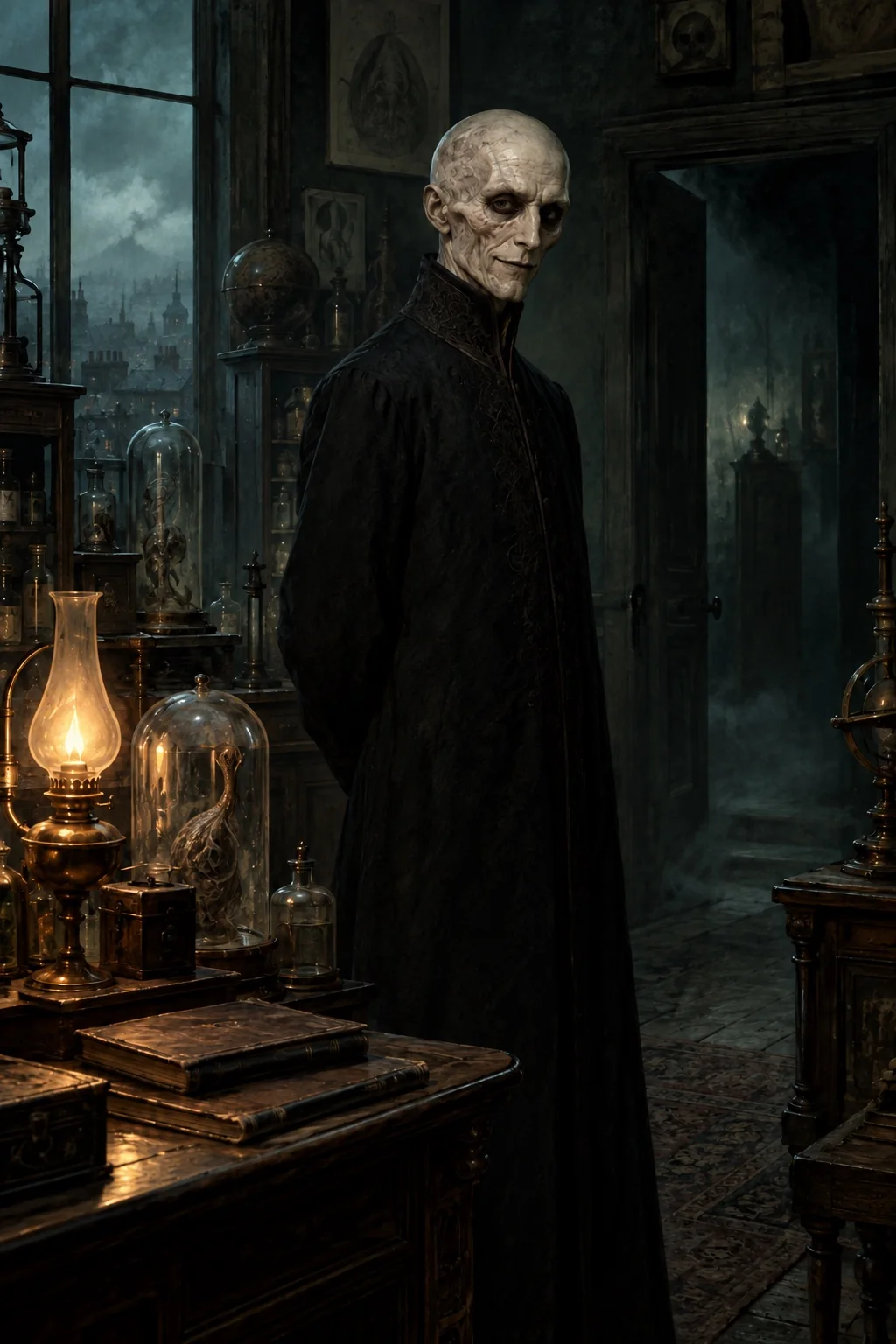
Surama is extremely thin, with a bald, skull-like head, parchment-colored skin and deep eye sockets. His characteristic low chuckle contributes to the impression that he finds ordinary human distress amusing. He wears clothing that hides the rest of his form.
His knowledge is extensive, and he can speak English without a revealing accent. These capacities make his history difficult to read from ordinary social cues. The people around him encounter an apparently educated attendant whose physical appearance nevertheless remains disturbing.
The decisive anatomical evidence comes after the clinic burns. One of the recovered skeletons corresponds to Clarendon; the other has a humanlike skull but a bodily structure not readily identified with a familiar human, ape or saurian pattern. The ending explains why concealing clothing mattered throughout the story.
This description permits an inhuman classification within the fiction but not a more exact taxonomy. Illustrations may imagine his concealed proportions; they should not present invented horns, wings, tentacles or a named species identity as details supplied by the text.
Sources: [1]
The vault in the Hoggar region
Clarendon's dying account places Surama in a sealed vault in the Hoggar region of North Africa. The physician reached it with the assistance of custodians who controlled access to knowledge unavailable through his ordinary scientific work.
The explanation connects Surama with an ancient Atlantean tradition and an immense prehistory. It gives the encounter a much older context than a modern doctor hiring a foreign assistant. It does not supply a precise date of Surama's birth or a complete history of the society from which he comes.
The information reaches the reader through a participant whose judgment has been compromised but who is now confessing. The anomalous remains corroborate Surama's difference more directly than they verify every historical claim made about the vault and its traditions.
The North African setting is part of the story's imagined occult geography. Its claims about local peoples and secret survivals should remain attributed to the fiction, rather than repeated as archaeological or ethnographic fact.
Sources: [1]
Teacher, accomplice and controller
Surama supplies knowledge that Clarendon believes can extend the reach of science beyond conventional limits. He assists in the laboratory, protects its privacy and participates in maintaining the household's isolation. When a reporter enters the grounds, Surama removes him with ease.
He also possesses direct coercive power. When the servant Tsanpo resists being taken to the clinic, Surama disarms and overpowers him. The incident shows that the partnership depends on force as well as intellectual fascination.
His influence does not make Clarendon a passive instrument. An overheard argument reveals that the physician has consumed experimental subjects faster than Surama wishes. Surama's complaint concerns the management of cruelty rather than a principled refusal to harm people.
The relationship consequently changes during the story. Clarendon first treats Surama's instruction as a route to unprecedented achievement, later blames him for corruption, and finally seeks to destroy him. The instructor remains dangerous, but the pupil's own ambition and willingness to experiment are indispensable causes of the deaths.
Sources: [1]
The alien fever
The most consequential knowledge Surama transmits concerns the black fever. Clarendon ultimately says that its true origin is extraterrestrial, contradicting the earlier association with Tibet. No particular planet is identified.
The illness does not spread through ordinary contact in the manner feared by the public. Clarendon deliberately introduces it into subjects. His insistence that it is noncontagious therefore conceals the mechanism of the outbreak while sounding like professional reassurance.
Surama's role is the transmission and encouragement of a practice that the physician carries out. The story does not establish that Surama can infect anyone at any distance by mere thought, nor does it describe a universal magical plague under his command.
The published medical work that precipitates Clarendon's confession does not solve the alien infection. The distinction between ordinary fever research and the resistant cases he created prevents the ending from becoming a conventional discovery-of-the-cure narrative.
Sources: [1]
Books, signs and invoked powers
The confrontation between teacher and pupil invokes the Azif associated with Alhazred, Irem and traditions of the Crimson Desert, along with several names familiar elsewhere in Lovecraftian fiction. Nyarlathotep and Shub-Niggurath belong to the exchange's larger occult background.
The names do not all denote beings physically present in the laboratory. Surama's practical response to threats and formulas gives immediate material dangers considerable importance. References to strange books elsewhere in the house also do not identify every volume as the Necronomicon.
An elder sign occurs without a prescribed visual design. A destructive flame is discussed as a possible means of dealing with Surama, alongside physical violence. These details should be recorded as particulars of this encounter, not converted into a universal hierarchy of spells or vulnerabilities.
Sources: [1]
Destruction and surviving uncertainty
Clarendon asks that the clinic, its contents and Surama be destroyed. The subsequent fire brings the partnership to its end. Strange impressions in the flames, the familiar chuckle and a lightning strike make the episode more than an ordinary laboratory accident, but the exact sequence is not fully witnessed from within.
The recovered skeleton supplies the clearest final evidence of Surama's hidden nature. Nothing in the ending establishes his successful escape, a later resurrection or an ongoing cult led by him.
His narrative function is to connect deep time with a modern institution capable of hiding abuse. The prison and laboratory provide vulnerable subjects; the ancient instructor supplies possibilities and encouragement; the celebrated scientist turns those possibilities into action. The horror depends on that collaboration rather than on antiquity alone.
Sources: [1]
Related music
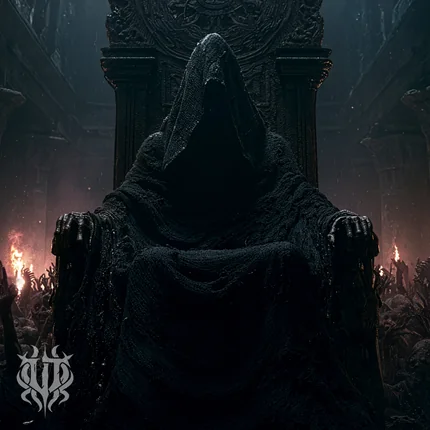
A Thousand Masks is a dark metal song inspired by Nyarlathotep, the Crawling Chaos who walks among humanity, hiding behind countless faces and whispered lies.
References
- The Last Test — original text
The fictional narrative is evidence for what the story says, not proof of events in the real world.
- The Last Test — publication data
- The Last Test — Project Gutenberg edition record
At a glance
The Last Test
Weird Tales, November 1928
Dr. Alfred Schuyler Clarendon
A sealed vault in the Hoggar region
Not identified
Destroyed in the clinic fire; anomalous remains recovered