

The Last Test
The Last Test follows a celebrated physician whose apparently principled struggle against political interference conceals experiments on unwilling human subjects. A prison outbreak, a damaged romance and an ancient adviser gradually converge on the truth about Dr. Alfred Schuyler Clarendon. Lovecraft revised a story by Adolphe de Castro; the resulting narrative combines medical melodrama with an extraterrestrial disease and references to forbidden traditions.
12 min read · 2,399 words
Authorship, form and publication
The composition record dates Lovecraft's work with Adolphe de Castro to 1927. The story appeared in the November 1928 Weird Tales, volume 12, number 5, on pages 625–656. Project Gutenberg identifies it as Lovecraft's revision of de Castro's A Sacrifice to Science. The earlier story and the published revision should not be treated as interchangeable texts.
The five-part narrative uses a third-person retrospective account, presenting a scandal whose public version differs sharply from what a few survivors know. Its opening places the events in San Francisco before the 1906 fire. The appointment that starts the crisis is dated 8 November in an unspecified year of the 1890s; supplying a complete calendar year would exceed the text.
The detailed synopsis below follows the published revision. It does not assign particular sentences or incidents to the earlier author without a comparison of the two versions.
Sources: The Last Test — original text, H. P. Lovecraft Archive — fiction in composition order, The Last Test — publication data, The Last Test — Project Gutenberg edition record, Robert M. Price — introduction to Black Forbidden Things
Clarendon, Georgina and the broken engagement
Alfred Schuyler Clarendon has achieved an international scientific reputation while still a young man. He represents himself as devoted to impersonal truth, placing research above ordinary affection and the value of individual lives. That intellectual posture initially appears inseparable from the discipline that made his career.
His sister Georgina manages his household and supports his work. Her former suitor, James Dalton, belongs to a family ruined by the financial dealings of the Clarendons' father. Dalton's father killed himself, and the elder Clarendon rejected the now-impoverished young man's proposal. James subsequently moved west and built a legal and political career.
A chance reunion in California brings the three together again. James is now governor, and his affection for Georgina has survived their separation. Alfred benefits from the renewed connection, receiving an appointment as medical director of the state penitentiary at San Quentin. His interest in the position includes the access it offers to human cases.
The family history explains why personal loyalty repeatedly interferes with judgment. Dalton wants to protect both Georgina and the brother she admires. Georgina has organized her life around Alfred's vocation. Alfred expects her continued service and regards her possible marriage as a loss to his work.
Sources: The Last Test — original text
The household and Surama
Clarendon occupies a large, enclosed residence near Goat Hill, with a separate clinic, animal cages and a high boundary wall. Its isolation makes the property suitable for private research and difficult for outsiders to observe. The domestic interior and the laboratory belong to the same household but operate under very different rules.
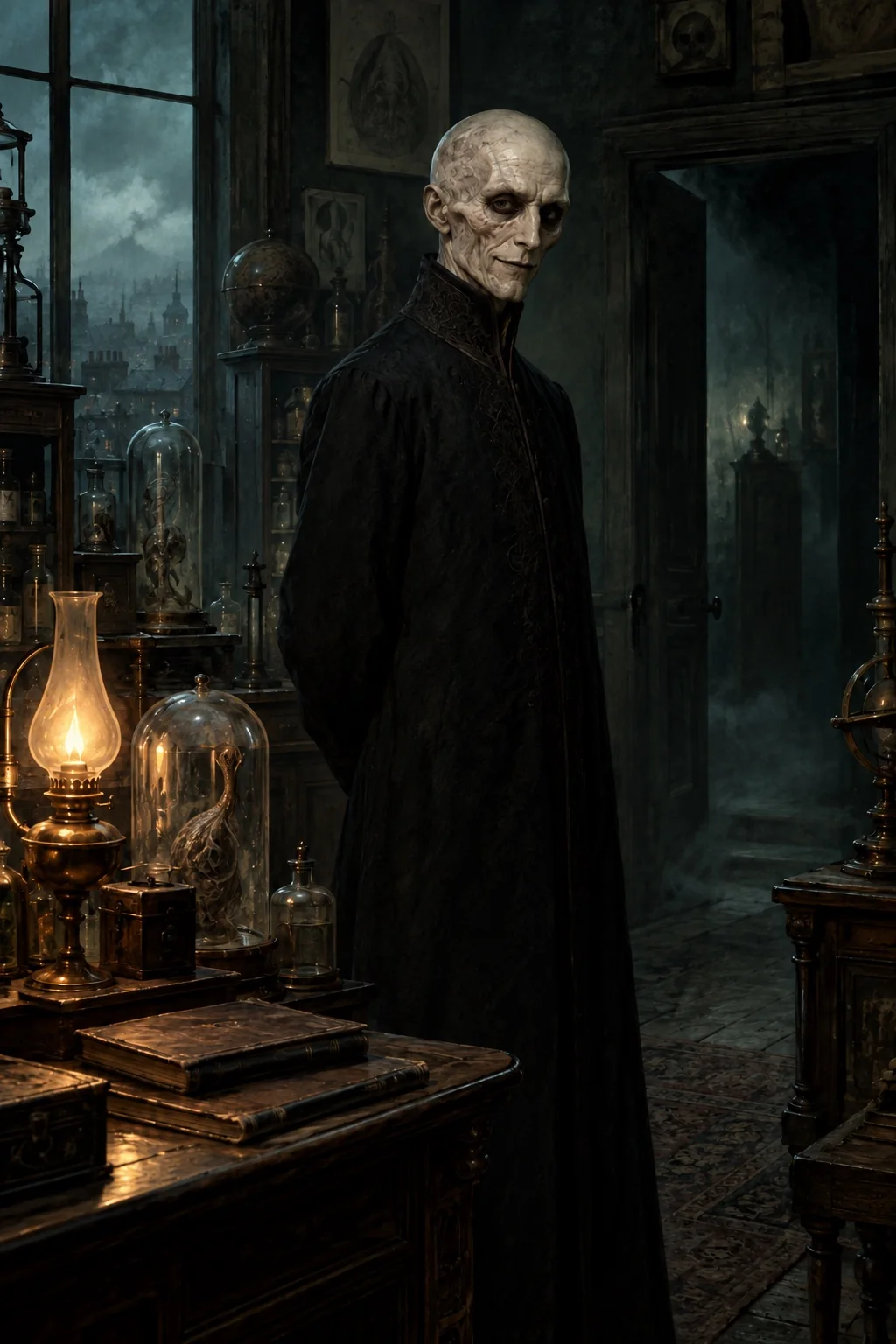
Eight Tibetan servants accompanied the physician from his travels. His associate Surama came from North Africa and appears exceptionally gaunt, bald and skull-faced. He possesses extensive learning, speaks English without a revealing foreign accent and has a disturbing, low chuckle. His clothes conceal the greater part of his body.
Georgina dislikes Surama's influence before she understands its nature. The deaf cook Margarita and the family dog Dick complete the most immediately important domestic circle. Their ordinary presence gives the clinic's secrecy a disturbing proximity: the experiments are taking place beside a recognizably inhabited home.
The travel background repeatedly invokes racialized ideas about Asia, Africa and ancient knowledge. These belong to the story's imaginative and prejudicial framework. They are not reliable ethnography, medical history or evidence that the named peoples actually preserved the practices attributed to them.
Sources: The Last Test — original text
Black fever at San Quentin
About a month after Clarendon's appointment, assistant physician Wilfred Jones reports an unusual fever. Clarendon already knows about the case, isolates the prisoner under his own supervision and insists that the illness is not contagious. A treatment appears briefly to help, but the patient dies and is buried with lime.
Further cases follow. Within roughly a week the number has reached forty, and the prison struggles to obtain nursing assistance. Dalton intervenes to make money and sentence reductions available as inducements, while nurses are recruited from the city.
Clarendon's exclusive control of the patients creates both professional resentment and a genuine obstacle to scrutiny. His refusal to share information can initially be read as an uncompromising investigator's resistance to interference. The ending will give that same behavior a much more sinister explanation.
The outbreak must be distinguished from the much larger panic it causes. The narrative does not describe an uncontrolled citywide spread of Clarendon's disease. Rumors and reporting drive people from San Francisco, while the resulting temporary settlements develop problems of their own, including ordinary illness.
Sources: The Last Test — original text
Panic, journalism and unreliable accusations
Sensational newspapers transform the prison cases into a civic emergency. Businesses suffer, people flee across the bay or toward the surrounding hills, and opportunistic remedies circulate. Later, reassuring reports help reverse the movement. The public's sense of danger follows a changing information market as well as the actual condition of patients.
One reporter scales the Clarendon property's wall. He sees the grounds and animal cages, encounters Dick, and is forcibly expelled by Surama. He subsequently invents an interview and a description of dying patients denied water in the interests of experimentation.
The invented article is an essential distinction in the evidence. The reporter has not witnessed the acts he describes. Clarendon's eventual confession establishes real crimes, but it does not retrospectively make this particular journalistic fabrication an accurate eyewitness account.
The episode also complicates the familiar picture of a persecuted genius. Some attacks on Clarendon are dishonest, and some opponents are self-interested. Neither fact establishes his innocence. The story allows institutional misconduct and the investigator's own criminal behavior to coexist.
Sources: The Last Test — original text
Political rivalry and dismissal
Jones is connected to the chairman of the prison board and uses that relationship against Clarendon. A legislative change transfers the relevant appointment power from the governor to the board. Clarendon, unaware of the change, assumes that Dalton's support still protects his position.
The confrontation becomes physical. When the board chairman and Jones challenge his authority, he assaults them and leaves with Surama. His dismissal in early March removes the prison access on which his work has depended. The political arrangements belong to this fictional plot and should not be cited as a factual account of California's administrative history.
Dalton's private position is equally difficult. He has renewed his proposal to Georgina, but Alfred refuses to release his sister from her domestic obligations. Georgina asks James to wait because she believes her brother is under exceptional strain.
A separate incident supplies an early warning. Dick draws Georgina and Dalton toward the clinic, where they hear what sounds like a child calling for its mother. They accept a reassuring explanation involving a parrot. Only later does the dialogue between Clarendon and Surama expose the human significance of the sound.
Sources: The Last Test — original text
The return to work and the disappearing servants
After the dismissal, Clarendon passes through a period of exhaustion and inactivity. Georgina interprets his changing condition through concern for his health and career. Surama remains an unwelcome presence, associated with strange chants and private practices.
In late May a strongly smelling package arrives from Algiers. A storm and an apparent nocturnal ceremony precede the physician's renewed activity. The narrative connects these events atmospherically without supplying a complete procedure that could be reconstructed as a coherent magical system.
An overheard conversation reveals a need for further human subjects. Surama proposes using the Tibetan servants and beginning with Tsanpo. When Tsanpo resists with a knife, Surama shoots the weapon from his hand and carries him toward the clinic. Georgina witnesses enough of the encounter to collapse.
The household then loses its servants. Dick becomes ill, and Alfred's indifference to the dog deepens Georgina's alarm. The physician increasingly describes individual beings as material available to research. His abstract commitment to truth has become an immediate threat to the people and animals within his reach.
Sources: The Last Test — original text
Georgina overhears the partnership breaking apart
On 28 May Georgina enters the clinic's outer portion and hears an argument beyond a locked door. Clarendon blames Surama for leading him toward forbidden knowledge and recalls the figure of Nyarlathotep. Surama answers that his pupil has become uncontrolled: the dog, the Mexican boy and all eight servants have been used up.
This exchange changes the status of earlier clues. The child's cry was not merely an exotic household noise, and the missing servants have not simply gone elsewhere. At the same time, Surama's rebuke shows that Clarendon's appetite for experimentation has exceeded even his instructor's preferred pace.
Clarendon invokes the Azif of Alhazred, traditions associated with Yemen and the Crimson Desert, Irem, Nug and Yeb, and Shub-Niggurath. Surama does not respond as an obedient creature bound by a successfully recited formula. He points instead to immediate physical dangers, including a firearm and the fever.
Georgina sends Margarita to summon Dalton. Her decision to break the clinic's domestic taboo and seek help is consequential: the plot's rescue depends on her recognizing that loyalty to her brother can no longer mean leaving his work unexamined.
Sources: The Last Test — original text
The proposed injection
Clarendon briefly appears solicitous when he finds Georgina distressed. His attention then turns to her apparent physical health, which makes her an attractive subject. He prepares an injection under the pretext of administering morphine.
Dalton arrives after delays in receiving the message. Georgina is sent upstairs, while the governor encounters an increasingly unstable scientist and papers written in Greek. The unfamiliar library and records place him outside the ordinary professional world in which he has understood his friend.
Dalton also carries a medical journal supplied by Dr. MacNeil. It contains an article by the Philadelphia researcher Dr. Miller announcing work on a fever serum. The publication gives the confrontation an unexpected direction. Clarendon reads it, collapses, and experiences a period of painful lucidity.
He injects himself with the substance intended for Georgina. This is the last experiment named by the title: the investigator becomes his own terminal subject. It is not a successful demonstration of a cure, nor does Georgina receive the planned inoculation.
Sources: The Last Test — original text
The explanation of the disease
Clarendon confesses that he never possessed the protective serum that observers had attributed to him. His respectable ambitions and scientific gifts were real, but the experiments have not brought him close to conquering the particular disease he introduced.
The black fever is not actually a Tibetan infection. According to the confession, Surama brought knowledge of an organism from beyond Earth. Its source is left unnamed. Clarendon has deliberately inoculated victims, using both a conventional instrument and a concealed syringe mechanism in a ring.
His earlier insistence that the disease is noncontagious therefore has a horrific second meaning. He can predict that ordinary contact will not spread it because he controls its introduction. The unusual concentration of cases around his activities is evidence of agency, not of a mysterious natural epidemic.
Miller's achievement must also be described carefully. His reported black-fever cases belong to ordinary disease categories. The resistant Pacific Coast cases, which Clarendon recognizes as his own, remain outside that success. The journal restores a measure of moral and intellectual perspective; it does not provide a conveniently available cure for the alien infection.
Sources: The Last Test — original text
What Surama is—and what remains unknown
Clarendon says that he obtained Surama from a sealed vault in the Hoggar region, reached with the assistance of local custodians. His account connects the hidden being with an ancient Atlantean tradition and forms of knowledge older than familiar human history.
These assertions are delivered through the dying participant's confession. The narrative strongly supports Surama's extraordinary nature, but it never supplies a modern species name, a fully dated biography or a complete account of the civilization that produced him.
The final physical evidence is a skeleton recovered from the destroyed clinic. Although the skull is humanlike, other features do not correspond neatly to either an ape or a saurian form. Clothing had concealed the differences in life. Calling Surama merely a human sorcerer would therefore miss the ending's material revelation; assigning him to a different named Mythos species would add information the text does not give.
His relationship to Clarendon involves instruction, manipulation and cruelty, but not complete control of every action. The physician acknowledges his own appetite for the experiments. The narrative's pity for a corrupted man should not erase that confession of responsibility.
Sources: The Last Test — original text
Fire, surviving papers and the public legend
Before dying, Clarendon asks Dalton to destroy the clinic, its contents and Surama. He distinguishes between records to be destroyed and material that can be sent to Miller. References to a destructive flame and to physical killing offer possible ways of dealing with Surama, without establishing a general rule for defeating all beings in the Mythos.
An exhausted Dalton falls asleep. He wakes to find the clinic burning and Clarendon gone. The survivors infer that the physician has initiated the destruction, but the account does not place Dalton beside him when the fire is started. Surama's laugh, abnormal impressions within the flames and a lightning strike make the conflagration an uncanny final encounter.
Two skeletons are recovered. The other victims have been disposed of separately. The public account preserves Clarendon as a scientist whose unfinished research might have surpassed Miller's, and even the hostile Jones later claims a connection with his prestige.
Dalton and Georgina marry, but their later happiness does not remove the memories. Familiar sounds, shapes, books and instruments can revive the experience. The narrative presents its privileged version as information that has gradually escaped the small circle of people who understood what happened.
Sources: The Last Test — original text
Ethics, knowledge and the Mythos connections
The story builds its reversal through an unstable resemblance between dedication and obsession. Clarendon's refusal to accept professional interference initially resembles integrity. His treatment of living beings eventually reveals the danger in an ideal of knowledge detached from any obligation to its subjects.
The victims are unevenly protected. Prisoners, servants and a child can disappear into the experiment more easily than the governor's prospective wife. Georgina's threatened death brings the danger into the emotional center of the narrative, but the preceding deaths remain central to assessing Clarendon's conduct.
Mythos references deepen the background rather than supplying a cast of gods who physically enter the action. Nyarlathotep, Shub-Niggurath and Yog-Sothoth are invoked or discussed; their names do not establish that each is visibly present. The Azif is identified, while other strange books remain unnamed. An elder sign appears in the action without a specified graphic design.
The most substantial supernatural mechanisms are therefore local and concrete: Surama's survival, his anomalous body, his transmitted knowledge and the intentionally administered disease. Keeping those mechanisms distinct from the more allusive names preserves the particular horror of this story.
Sources: The Last Test — original text
Related music
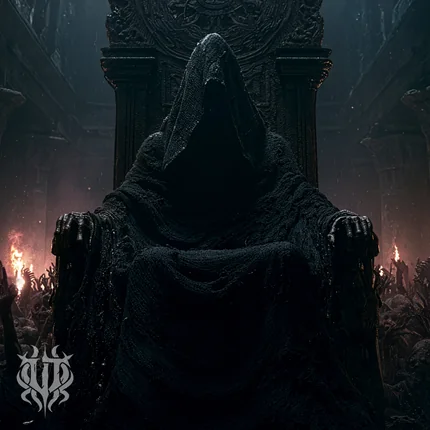
A Thousand Masks is a dark metal song inspired by Nyarlathotep, the Crawling Chaos who walks among humanity, hiding behind countless faces and whispered lies.
References
- The Last Test — original text
The fictional narrative is evidence for what the story says, not proof of events in the real world.
- H. P. Lovecraft Archive — fiction in composition order
Composition dates; question marks and ranges retain the source uncertainty.
- The Last Test — publication data
- The Last Test — Project Gutenberg edition record
- Robert M. Price — introduction to Black Forbidden Things
At a glance
H. P. Lovecraft; Adolphe de Castro
1927
1928, November
Weird Tales, 12, No. 5
Fiction