

The Thing on the Doorstep
The Thing on the Doorstep follows Daniel Upton’s attempt to justify shooting his closest friend by reconstructing a marriage, a series of personality exchanges and a final visit from a body that should no longer be alive. Its horror turns on the difference between recognizing a familiar body and identifying the mind inside it.
9 min read · 1,718 words
Composition and first publication
Lovecraft wrote the story on 21–24 August 1933. It first appeared in the January 1937 issue of Weird Tales, volume 29, number 1. The interval matters when placing it among his later works: its publication shortly before his death does not mean that it was composed in his final months.
The first-person statement begins after the central act of violence. Daniel Upton admits firing six bullets into Edward Derby’s head at the Arkham Sanitarium but disputes the conclusion that he has murdered his friend. The rest of the narrative assembles the evidence by which he hopes to separate the body he shot from the identity he believes had already been destroyed.
Sources: H. P. Lovecraft Archive — fiction in composition order, H. P. Lovecraft Archive — fiction in publication order, The Thing on the Doorstep — Unspeakable Tales ebook
Edward Derby before the marriage
Edward Pickman Derby is eight years younger than Upton, who has known him since childhood. Derby’s precocious poetry and immense book learning develop inside an exceptionally protective household. He publishes Azathoth and Other Horrors while still young, corresponds with the poet Justin Geoffrey and studies at Miskatonic because his parents will not let him live away from home.
His intellectual sophistication contrasts with his practical dependence. He avoids independent travel, struggles to make decisions and relies on his parents and Upton for ordinary affairs. Upton becomes an architect, marries and names his son Edward Derby Upton in his friend’s honor. Their long familiarity gives the later changes a personal standard of comparison.
Derby signals his visits with a distinctive sequence: three quick strokes followed, after a pause, by two more. At first this is a small household custom. By the ending it becomes evidence of identity that a familiar face cannot provide. The story establishes the signal well before the reader knows it will have to function as a test.
Sources: The Thing on the Doorstep — Unspeakable Tales ebook
Asenath Waite and the Innsmouth connection
Derby meets Asenath Waite when he is thirty-eight and she is approximately twenty-three. She is studying medieval metaphysics at Miskatonic and shares the occult interests that have increasingly absorbed him. Her earlier education at the Hall School in Kingsport has left a reputation for hypnosis, troubling displays of knowledge and apparent exchanges of personality with other pupils.
Asenath comes from Innsmouth. Her father, Ephraim Waite, was a feared occult scholar who died under disturbing circumstances. Reports about her veiled mother, the family house and Ephraim’s final confinement connect the marriage to a history that Upton only gradually learns to read.
The couple settles in the old Crowninshield house in Arkham. Asenath brings books, equipment and three servants from Innsmouth. This transfer makes the connection between the two towns concrete: people, objects and practices move into an existing Arkham household. Innsmouth is more than a name added to the background.
Sources: The Thing on the Doorstep — Unspeakable Tales ebook
A marriage marked by changing identities
Over the next two years Derby becomes more withdrawn. He says less about his studies and avoids discussing his wife. At the same time, observers occasionally see him acting with a force and competence alien to his usual behavior. He drives Asenath’s car confidently even though the Derby they know has never learned to drive.
These episodes alternate with his familiar uncertainty. He may leave in control of the car and return helplessly in the back seat while someone else drives. A visitor also glimpses Asenath at an upstairs window with an expression that seems to belong to the distressed Edward.
Derby eventually tells Upton that Asenath takes possession of his body and leaves him in hers. Her control is not yet continuous, so he sometimes returns to himself in distant places where the occupying mind has carried him. What first appears to be a fluctuating temperament becomes a pattern with a possible spatial explanation: one body moves while the other remains confined at home.
Sources: The Thing on the Doorstep — Unspeakable Tales ebook
The journey from Chesuncook
The immediate crisis begins when a marshal in Chesuncook, Maine, telegraphs Upton about Derby, who has emerged from the woods in a terrified state. Upton travels to retrieve him. Derby speaks of vast stairs beneath ruins, a gathering of hundreds, shoggoths and rites associated with Shub-Niggurath. He identifies Kamog as Ephraim’s secret coven name.
On the return drive, Derby tries to explain the continuity between Ephraim and Asenath. Her unguarded handwriting resembles the old man’s, and her knowledge and expression seem to preserve his personality. Derby suspects that Ephraim exchanged bodies with his daughter when his own body approached death, then killed the body into which he had forced her.
Before he can finish, a sudden transformation occurs beside Upton. Derby’s speech, posture, expression and confidence change. The figure takes the wheel, dismisses the earlier account as an episode caused by overstudy and drives them back to Arkham. Upton has now witnessed something corresponding to his friend’s claims, although he remains unable to accept the full explanation.
Sources: The Thing on the Doorstep — Unspeakable Tales ebook
The apparent separation
In October, Derby arrives using the old door signal and claims that Asenath has left after he resisted her. He says she has gone to New York and may seek a divorce. He has dismissed the three servants and plans to return to his father’s house.
He also states more directly that the mind occupying Asenath is Ephraim’s. The proposed permanent exchange with Derby would provide a new body after the earlier seizure of the daughter. In this explanation, the threat is a continuing individual extending its life through successive victims.
The apparent liberation does not last. Derby delays moving, remains preoccupied with the cellar and sends regular payments to the discharged servants. Upton hopes for rest and travel, but Derby’s alternating agitation and fear suggest that something unresolved remains inside the Crowninshield house.
Sources: The Thing on the Doorstep — Unspeakable Tales ebook
The sanitarium and the false recovery
Around Christmas, Derby suffers a severe episode in Upton’s home and says that the force is still reaching for him, even across death. His condition worsens until Upton consults the relevant professionals and has him taken to the Arkham Sanitarium. Upton becomes his guardian and continues to visit.
In late January the institution reports a sudden recovery. The patient appears rational and expects release, although his recent memory is incomplete. Upton, however, recognizes the decisive, ironic personality that had taken over during the drive from Maine.
The episode reverses the expected meaning of recovery. The behavior that reassures the staff is precisely what alarms the person who knows Derby best. Competent speech and a calm manner may indicate successful occupation rather than the return of the original self. The story’s conflict over identity cannot be settled by outward composure alone.
Sources: The Thing on the Doorstep — Unspeakable Tales ebook
The visitor and the final letter
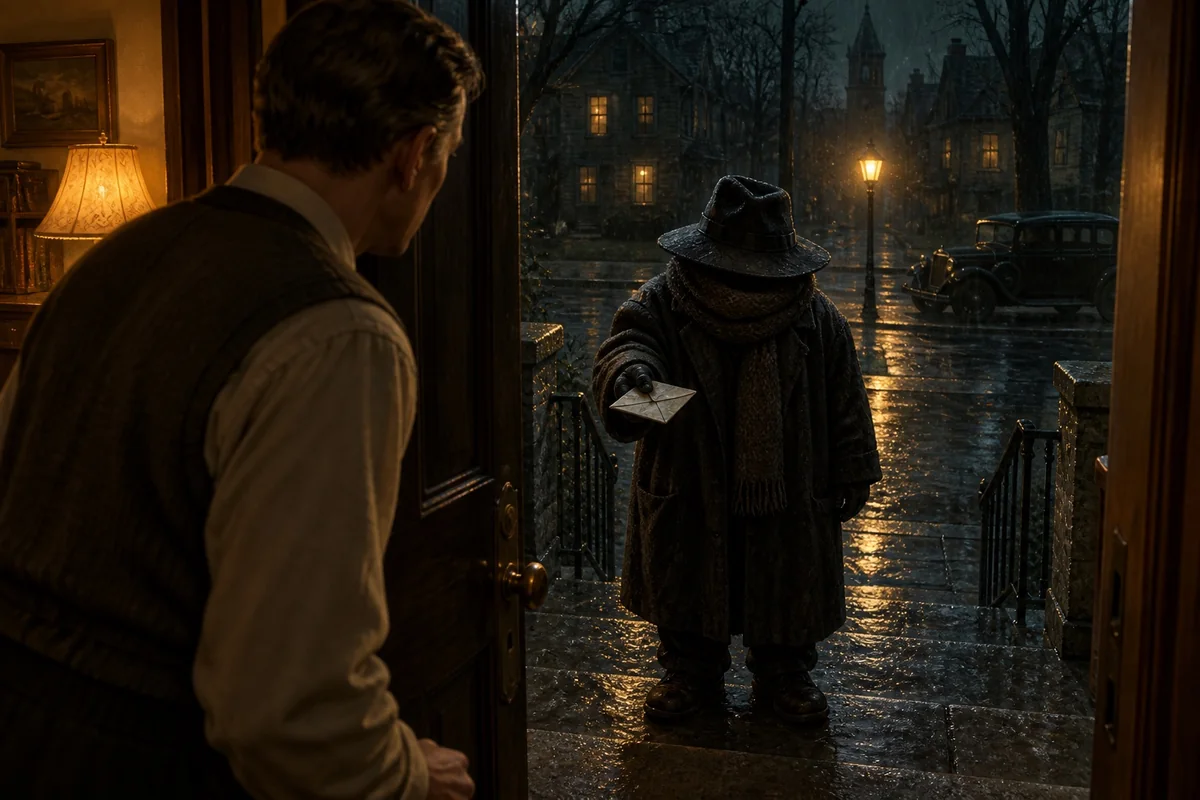
Shortly before midnight Upton receives a telephone call consisting of wet, unintelligible sounds. It is later traced to the Crowninshield house. Around two in the morning, something at his door struggles to reproduce Derby’s familiar signal.
The visitor is short, deformed in outline, foul-smelling and hidden inside Edward’s oversized clothing. It cannot speak coherently but presents a written message. The letter confesses that Derby killed Asenath with a candlestick in October and buried the body beneath boxes in a remote cellar storeroom. The departure story was a lie.
Death did not end the occupying mind’s power. It continued to draw Derby out of his living body until he found himself inside the decaying remains he had buried. He escaped the cellar, attempted to telephone and made the journey to Upton because he could still write. The message asks Upton to destroy the being now occupying Edward’s body and ensure its cremation.
The visitor collapses. Dental work identifies the crushed skull as Asenath’s, giving the final scene a form of physical corroboration independent of the clothing. Upton subsequently shoots the sanitarium patient. He remains terrified because the body has been retained for examination instead of immediately cremated.
Sources: The Thing on the Doorstep — Unspeakable Tales ebook
The sequence of possession
According to Derby’s explanation, Ephraim first exchanges with Asenath, then poisons his original body while his daughter is trapped inside it. The consciousness later presented socially as Asenath is therefore Ephraim continuing through her body. Derby becomes the next intended host.
Temporary exchanges during the marriage precede the permanent seizure. Derby’s murder of the occupied Asenath body interrupts the visible relationship but does not prevent the remaining consciousness from reaching him. The final exchange leaves Ephraim in Edward’s living body and Edward in Asenath’s corpse.
This sequence distinguishes three identities from three successive physical forms. It also explains why calling the story simply a wife possessing her husband is incomplete. Asenath’s own early victimization belongs to the disclosure, even though Upton and Derby continue to use unstable gendered terms while trying to describe what they believe has happened.
Sources: The Thing on the Doorstep — Unspeakable Tales ebook
Agency, gender and the narrative’s prejudices
Derby’s vulnerability is presented through a life in which other people have repeatedly made decisions for him. The marriage converts that pattern into literal control of his body. Intellectual ability alone offers little protection when his practical autonomy is underdeveloped and his access to friends can be monitored.
The claim that a male brain possesses superior occult capabilities belongs to Asenath/Ephraim’s stated beliefs. It is not a fact the encyclopedia should endorse about sex or intelligence. The plot’s pursuit of a male host combines that belief with the desire for a body understood by the characters as more fully human.
The story also draws on fears about Innsmouth ancestry and bodily difference. Those fears shape the narrators’ language, but the central injury is the forcible displacement of a person. A critical reading can examine the historical prejudices while still tracing the concrete acts of coercion, concealment and attempted escape that organize the plot.
Sources: The Thing on the Doorstep — Unspeakable Tales ebook
Evidence and the problem of Upton’s account
Upton is explaining an act that others can reasonably regard as homicide. He controls the narrative and acknowledges that his own state of mind may be questioned. His insistence should therefore be distinguished from the independently observable details he supplies.
The evidence accumulates through different channels: other people’s observations of changed behavior, the driving episode, handwriting, the repeated door signal, the traced telephone call, the letter and the remains. No single element carries the entire explanation. Their conjunction is what Upton believes makes an ordinary account inadequate.
The ending does not give him peace. He has acted on the theory that identity survives bodily death, yet that same theory leaves him afraid that shooting the occupied body may be insufficient. The confession’s opening claim of successful vengeance is therefore shadowed by a continuing practical uncertainty about the surviving force.
Sources: The Thing on the Doorstep — Unspeakable Tales ebook
Related music

The Black Goat of The Woods is a dark metal tribute to Shub-Niggurath, the ancient woodland deity whose forgotten cults gather beneath twisted trees and indifferent stars.
References
- H. P. Lovecraft Archive — fiction in composition order
Composition dates; question marks and ranges retain the source uncertainty.
- H. P. Lovecraft Archive — fiction in publication order
First publication dates and venues; issue dates can differ from actual release dates.
- The Thing on the Doorstep — Unspeakable Tales ebook
The fictional narrative is evidence for what the story says, not proof of events in the real world.
At a glance
H. P. Lovecraft
21–24 August 1933
1937, January
Weird Tales, 29, No. 1
Fiction