

Dylath-Leen
Dylath-Leen is the basalt port on the Southern Sea where Randolph Carter seeks passage to Oriab in The Dream-Quest of Unknown Kadath. Its international trade provides information and transport, but its appetite for rare rubies sustains dealings with the sinister black galleys. Carter is abducted there, returns after a lunar rescue and fails to secure a complete end to the dangerous commerce.
5 min read · 887 words
The road from Ulthar
Atal directs Carter toward Dylath-Leen because ships from distant regions bring knowledge unavailable in Ulthar. Carter travels with merchants carrying wool and cabbages along the road beside the Skai.
The journey passes farms, fishing towns and river traffic. After six days of travel, smoke and the city's towers appear on the seventh. The contrast between the pleasant approach and the dark port makes its atmosphere an immediate change of world.
Dylath-Leen consequently serves as a junction between the agricultural river country and maritime routes. Its importance comes from those connections as much as from the unusual ships that visit it.
Basalt towers and waterfront streets
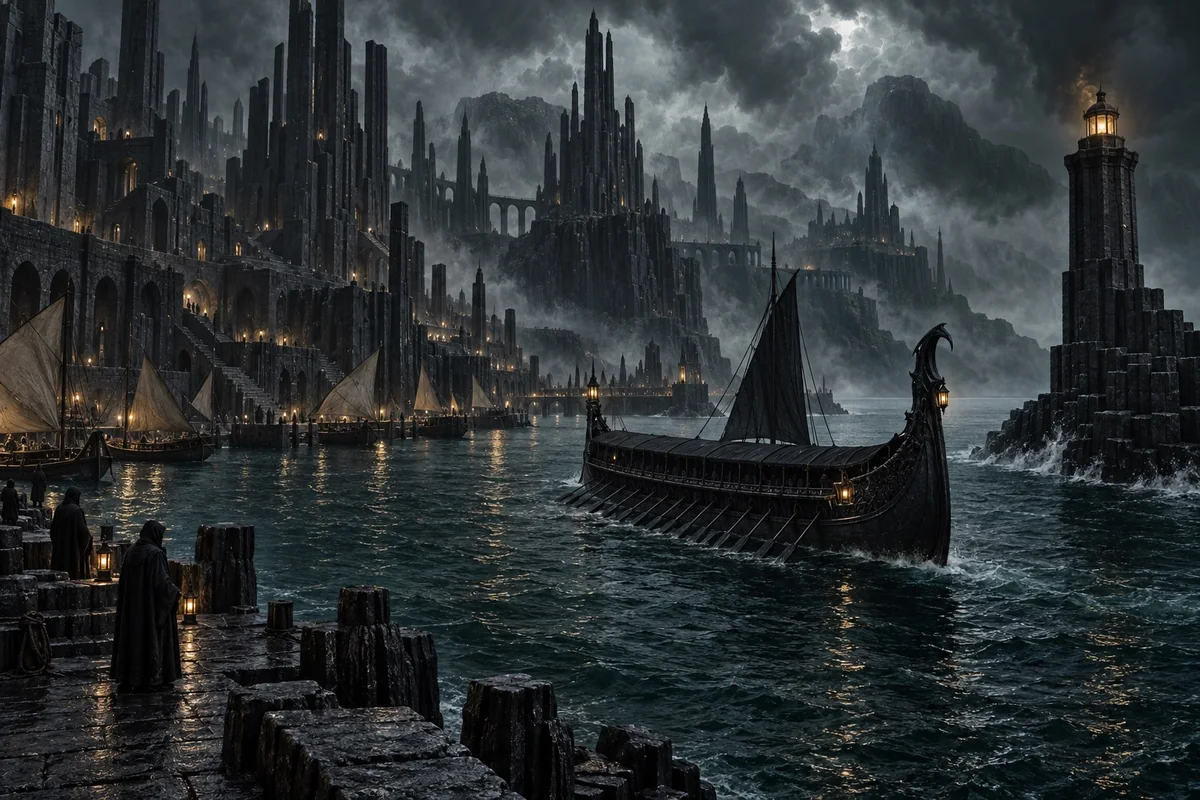
The city is built largely of basalt, with thin angular towers whose distant appearance the narrator compares to the Giant's Causeway. Dark streets lead among taverns and numerous wharves.
A basalt mole and tall lighthouse mark the harbor entrance. The waterfront is crowded with sailors and traders from many lands, including places whose relation to the earth is uncertain. This mixture makes the city valuable to a traveler seeking obscure geographical knowledge.
The text provides a strong architectural character but no complete street plan. Illustrations can follow its basalt, narrow towers, quays and lighthouse without inventing a canonical arrangement of every district.
Information about Oriab
Carter asks about the mountain Ngranek and learns that ships connect Dylath-Leen with Baharna on Oriab. One is expected to return there after a delay, giving him time to investigate other possible sources of knowledge.
The sailors know of the carved divine face on the mountain but emphasize the difficulty of reaching it. Their information distinguishes a familiar island and trade route from a much less accessible object within that island.
Carter also seeks news of Kadath and his sunset city. The breadth of the port's connections does not guarantee an answer. One merchant reputedly associated with Leng appears potentially knowledgeable but proves unhelpful.
The black galleys
The visiting black galleys have three banks of oars and bring rubies of exceptional quality. Their trading representatives resemble humans sufficiently to conduct business, but their concealed physical features and unfamiliar manners disturb observers.
The rowers remain unseen, even during extended stays. No ordinary provisions are taken aboard, and strong odors drift from the vessels. These details accumulate as reasons for suspicion before Carter discovers who operates the ships.
The city tolerates the trade because no known mine in the earth's dream region supplies equivalent stones. Commercial desire overrides the residents' awareness that something is seriously wrong.
The purchase of people
The galley merchants acquire gold and enslaved people from Parg, across the river. Carter notices the absence of normal food purchases alongside that traffic, then encounters disturbing evidence during his abduction that forces him to reconsider the captives' destination.
Lovecraft's account describes the people of Parg in racialized and dehumanizing language. Their treatment should be explained as part of the fictional system of enslavement and the author's prejudiced representation, not reproduced as an exotic decorative detail.
The later lunar scenes reveal a larger economy in which the apparently human traders are themselves subordinated to the moon-beasts. The port is connected to that system through transactions it chooses to continue.
Carter’s abduction
On the third evening of a galley's stay, a merchant approaches Carter with hints of useful secret knowledge. Carter invites him to a private room, hoping to learn more, and offers the zoogs' wine.
The merchant responds with wine from a bottle carved from a single ruby. A small taste renders Carter unconscious. He wakes aboard the galley, whose destination takes him through the western cataract and eventually to the moon.
The episode turns Carter's usual method of exchanging hospitality for information against him. His desire to pursue every possible lead leaves him vulnerable to someone who has learned the purpose of his quest.
Rescue and the unanswered warning
After the cats rescue Carter on the moon, he asks them to return him to Dylath-Leen. He wants to resume the journey to Oriab and warn the city about the black ships.
He arrives in his former room and learns that a week has passed since the abduction. During the remaining wait he tells the residents what he can about the galleys. Many believe him, yet the jewelers will not give a complete promise to stop trading for the rubies.
The story leaves any future consequence unresolved. It establishes a choice to preserve profitable commerce despite credible warning; it does not narrate a later destruction of Dylath-Leen.
Ordinary shipping and onward passage
The ship from Baharna offers a different kind of maritime connection. It has painted sides, yellow lateen sails and a captain willing to discuss the route. Its cargo includes resin, pottery and small lava carvings.
The exchange involves goods from several regions, including Ulthar wool, Hatheg textiles and Parg ivory carving. These details give the port a wider economy than the ruby trade alone.
Carter arranges passage and leaves at a turn of the tide. The departure restores his intended journey, but the abduction has already exposed a dimension of the Dreamlands' commerce that a normal voyage would not have shown him.
References
- The Dream-Quest of Unknown Kadath — original text
The fictional narrative is evidence for what the story says, not proof of events in the real world.
At a glance
The Dream-Quest of Unknown Kadath
Southern Sea port linked to the Skai country
Mostly basalt; thin angular towers
Basalt mole and tall lighthouse
Baharna on Oriab
Black galleys with concealed crews
Abduction, return and warning
No destruction narrated