

Nodens
Nodens appears in Lovecraft as an ancient figure associated with the Great Abyss, marine wonders and the night-gaunts. He welcomes Thomas Olney into a supernatural procession and helps Randolph Carter escape Nyarlathotep. His name has an earlier religious and literary history, but those layers should remain distinguishable from the particular roles he plays in Lovecraft’s stories.
4 min read · 793 words
A name older than the Mythos
Nodens is not a name Lovecraft invented. Roman Inscriptions of Britain records a Lydney mosaic whose dedication is interpreted as addressing Mars Nodens and naming Titus Flavius Senilis and Victorinus. Its commentary discusses the possibility that Victorinus interpreted dreams in a healing cult.
A separate lead inscription appeals to Nodens over a lost ring, asking that health be withheld until its return. These are material witnesses to an ancient cult. They do not establish the appearance, night-gaunt servants or cosmic relationships later assigned to a literary figure.
Machen’s fictional inscription
Near the end of The Great God Pan, Clarke reports a museum pillar bearing a dedication to Nodens. The passage associates the name with the great deep or abyss and attributes the monument to Flavius Senilis after a disturbing witnessed union.
This is a document inside Machen’s fiction, connected with the mystery he has narrated. It is not the actual wording of the Lydney mosaic. The shared names make comparison fruitful, but the literary pillar’s event should not be added to a catalogue of real Roman inscriptions.
Lovecraft’s use of the name and abyssal title can be read beside this earlier literary appearance without pretending that the two authors present an identical character with a continuous biography.
Arrival at the high house
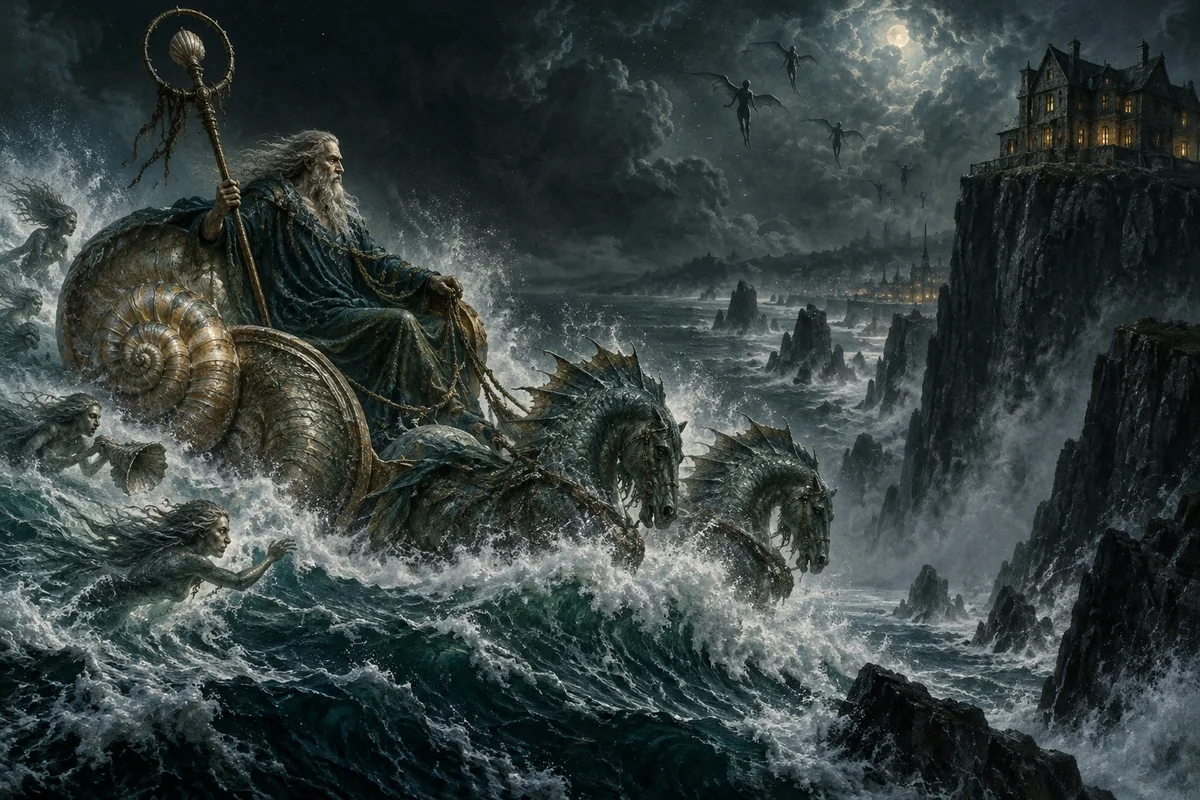
The Strange High House in the Mist presents Nodens among a company of marine powers visiting the unnamed host above Kingsport. Neptune, tritons and nereids accompany the procession.
Nodens appears as an aged, grey and formidable figure riding in an enormous shell supported by dolphins. He reaches out a withered hand to help Olney and the host aboard, and the company departs into the surrounding mist and sky.
The action is welcoming in this scene. It does not make Nodens the owner of the house: the host has already received Olney and separately joins the visitor in the shell.
Sources: [4]
The result for Thomas Olney
Olney returns bodily the next day but can no longer adequately recall his experience. The Terrible Old Man believes that his imaginative spirit remains above, an interpretation supported by the contrast between his later dutiful life and the new joy heard in the cottage.
Nodens is part of the procession that takes Olney away, but the narrative does not explicitly accuse him of stealing the philosopher’s soul or explain a deliberate extraction. Equally, the ambiguous result complicates any claim that his appearance guarantees ordinary human well-being.
His help at the shell is a specific action within an experience whose final value remains divided between the ordinary and imaginative worlds.
Sources: [4]
Lord of the night-gaunts
The Dream-Quest of Unknown Kadath identifies Nodens as the lord acknowledged by the night-gaunts. This distinguishes them from beings serving Nyarlathotep and contributes to Carter’s hope that their assistance might strengthen his approach to Kadath.
The night-gaunts initially carry Carter away from Ngranek and later become allies through his ghoul companions. Their relationship with Nodens does not turn every encounter with them into friendly treatment of humans.
The distinction between allegiance and power is also explicit. Although the Other Gods do not rule the night-gaunts, they can still seize and control Carter’s airborne company when it approaches Kadath.
Sources: [5]
Aid in Carter’s escape
During the final crisis, Carter leaps from the shantak carrying him toward Azathoth and turns toward the remembered waking world. S’ngac points the way, while Nodens calls guidance from the depths.
Nodens cries out in triumph when Nyarlathotep’s pursuit is frustrated and a blaze of light destroys the formless hunting horrors. The story gives him a clear role in the successful escape, while Carter’s recognition of his own dreaming state remains essential.
This episode supports calling him an opponent of Nyarlathotep in that encounter. It does not establish a universal promise to rescue everyone threatened by the Mythos or show him defeating all the Other Gods in a final war.
Sources: [5]
Why a simple moral classification is insufficient
The two main appearances combine assistance with remoteness. Nodens helps particular visitors, belongs to a world beyond ordinary human life and is associated with servants who can terrify as well as protect.
A later framework of benevolent Elder Gods may organize these details differently, but the primary scenes should remain visible beneath any classification. Lovecraft supplies particular gestures, loyalties and interventions rather than a complete moral creed or a documented plan for humanity’s salvation.
An illustration grounded in the high-house story can use the aged figure, marine procession, dolphins and great shell. A horned warrior, crowned king or armored human rescuer would need to be identified as another interpretation rather than the literal description in that passage.
Related music
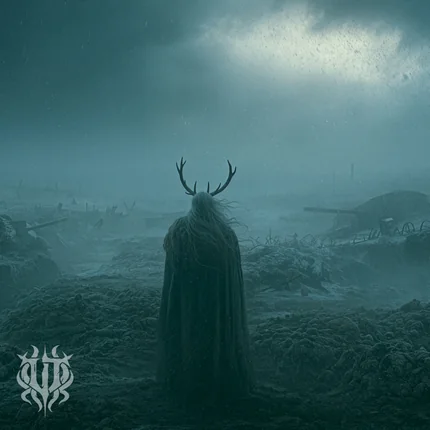
The Dreamkeeper is a dark metal journey into the Dreamlands, inspired by Nodens, the ancient guardian who watches over the boundary between dreams and the unknown.
References
- Roman Inscriptions of Britain — RIB 2448.3, Lydney mosaic
A real inscription and its scholarly interpretation, distinct from the fictional inscription in Machen.
- Roman Inscriptions of Britain — RIB 306, curse upon Senicianus
Historical religious evidence; not evidence that Lovecraft’s fictional events occurred.
- Arthur Machen — The Great God Pan, full text
The 1894 literary work is public domain in the United States. Its museum inscription is part of the fiction.
- The Strange High House in the Mist — original text
The fictional narrative is evidence for what the story says, not proof of events in the real world.
- The Dream-Quest of Unknown Kadath — original text
The fictional narrative is evidence for what the story says, not proof of events in the real world.
At a glance
Nodens, attested in Roman Britain
Arthur Machen, The Great God Pan
Lord of the Great Abyss
Night-gaunts
Aged figure in a great shell supported by dolphins
Thomas Olney; Randolph Carter