

The King in Yellow
The King in Yellow is Robert W. Chambers’s 1895 collection of supernatural, romantic and artistic tales, together with a sequence of short prose pieces. Its first four stories are connected by an invented play whose beauty and revelations damage its readers. The book’s wider contents extend beyond that premise, making edition history and the distinction between the real collection and the fictional drama essential.
7 min read · 1,364 words

The real book and its original contents
The Library of Congress holds a digitized copy published in New York by F. T. Neely in 1895. The original collection contains ten principal items: The Repairer of Reputations; The Mask; In the Court of the Dragon; The Yellow Sign; The Demoiselle d’Ys; The Prophets’ Paradise; The Street of the Four Winds; The Street of the First Shell; The Street of Our Lady of the Fields; and Rue Barrée.
The Prophets’ Paradise is itself a sequence of short titled pieces. The table of contents should not be read as a promise that every item tells another chapter of one continuous plot. The book changes form, setting and tone as it proceeds.
Within the first four stories, The King in Yellow is also the name of a fictional drama. Its complete text is not printed in the collection. The King, the play and Chambers’s actual published book are related but different subjects.
Sources: Library of Congress — The King in Yellow, F. T. Neely, 1895, Robert W. Chambers — The King in Yellow, Standard Ebooks text, Robert W. Chambers — In the Court of the Dragon
Edition differences that affect reading
The 1902 Harper and Brothers version omits In the Court of the Dragon. The Encyclopedia of Science Fiction records that cut and a differently abridged 1929 edition titled The Mask, and Other Stories. A changed title or familiar cover therefore does not guarantee identical contents.
The Project Gutenberg 8492 transcription and the Standard Ebooks text checked for this encyclopedia likewise lack the Dragon story. They remain useful sources for the other included works, but a separate 1895 transcription is used here to restore the missing part of the original sequence.
For citation, the practical distinction is between a claim about the original collection and a claim about a particular available edition. The omission is consequential because the Dragon story gives the King a final speaking presence and develops Carcosa’s visionary landscape in ways the other tales do not repeat exactly.
Sources: Robert W. Chambers — biographical reference, Library of Congress — The King in Yellow, F. T. Neely, 1895, Robert W. Chambers — The King in Yellow, Standard Ebooks text, Robert W. Chambers — In the Court of the Dragon
The Repairer of Reputations: an imagined empire
Hildred Castaigne narrates an American future dated to 1920. After a head injury, confinement and the reading of the forbidden play, he becomes convinced of his claim to an imperial crown. Mr. Wilde’s manuscript supplies a genealogy linked to Carcosa, Hastur and the Hyades.
Ordinary relationships become political obstacles. His cousin Louis’s planned marriage to Constance Hawberk accelerates a scheme involving coercion and threatened murder. Hildred’s jeweled crown and secure safe receive much cheaper descriptions from Louis, allowing readers to see the gap between confidence and evidence.
The projected accession ends with Wilde’s death, police intervention and Hildred’s confinement. People he believes dead appear alive, but he reinterprets the contradiction as a stolen throne. The opening story thus makes the forbidden drama inseparable from a dangerous practice of misreading the world.
Sources: Robert W. Chambers — The King in Yellow, Standard Ebooks text
The Mask: preservation, grief and return
Alec’s account centers on the sculptor Boris Yvain, Geneviève and Jack Scott. Boris discovers a liquid that seems to turn living things into flawless marble. His experiment crosses the boundary between making an image and preserving or destroying a life.
Concealed love fractures the friendship. Geneviève’s apparent death in the solution is followed by Boris’s suicide, and Alec spends years away. The forbidden play enters his fevered visions but does not supply a simple explanation of every event.
On his return, transformed animals and a flower recover life. Geneviève then awakens. The ending allows a form of restoration while leaving Boris dead and the mechanism unexplained. Its emotional movement differs from the irreversible collapse at the end of Hildred’s story.
Sources: Robert W. Chambers — The King in Yellow, Standard Ebooks text
In the Court of the Dragon: the failed sanctuary
An exhausted reader enters St. Barnabé hoping for relief. The organ sounds like a hunt, and the organist repeatedly appears with a look of personal hatred. The narrator flees through Paris, only to find the pursuer near each intended refuge.
The apparent chase ends in his own courtyard and then returns him abruptly to the church. He may have slept through the sermon, but recognition of the organist and a connection with his own past guilt make physical safety insufficient.
The church disappears from his perception, replaced by black stars, Lake Hali and Carcosa. The King’s final voice gives the catastrophe a religious and spiritual dimension. The story supplies no external report that resolves the relation between dream, memory and supernatural attack.
The Yellow Sign: an object recognized too late
The painter Mr. Scott and his model Tessie experience complementary dreams of a hearse driven by a repellent watchman. A separate witness reports that a finger detached from the man’s hand. Scott’s artistic work and ordinary attempts at explanation become increasingly inadequate.
Tessie gives him a black onyx clasp with a gold mark. After discovering and reading the play, they recognize it as the Yellow Sign. Scott cannot make himself discard it. The watchman arrives to retrieve it, and the encounter leaves Tessie dead and Scott dying.
The physician’s finding that the watchman has already been dead for months brings an impossible physical fact into the final scene. Scott’s dying account nevertheless refuses a complete explanation. The story links intimacy, reading and a small material object to a catastrophe whose wider meaning remains withheld.
Sources: Robert W. Chambers — The King in Yellow, Standard Ebooks text
The Demoiselle d’Ys and a different supernatural desire
The fifth story follows Philip, an American lost on the Breton moors, into Jeanne d’Ys’s isolated household. Old language, clothes and customs gradually suggest a different historical world. The two fall in love before a snakebite interrupts the encounter.
Philip wakes among ruins and finds a memorial recording Jeanne’s death in 1573 for love of a stranger with his name. A still-warm glove remains beside the ancient inscription. The closing contrast makes the experience both temporally remote and personally immediate.
The forbidden play does not drive this story. A falconer named Hastur provides a recognizable verbal connection, but his role is not revealed as divine. The emotional center is the loss of a desired world rather than escape from one.
Sources: Robert W. Chambers — The King in Yellow, Standard Ebooks text
Fragments of an absent drama
The collection gives readers songs, short exchanges and reported effects instead of the whole fictional play. Cassilda, Camilla, a Stranger, the Pallid Mask, Carcosa and Hali recur without a complete cast list, synopsis or cosmology.
That incompleteness lets recognition operate across separate stories. A phrase heard in one context can become ominous in another even when neither speaker can explain it fully. The device resembles an archive with gaps, but the gaps are created by Chambers as part of the work rather than left by the loss of a real ancient manuscript.
A complete modern script using these fragments is consequently a later creative reconstruction. It can be related to the collection, but its additional scenes and explanations should not be attributed to Chambers.
Sources: Robert W. Chambers — The King in Yellow, Standard Ebooks text, Robert W. Chambers — In the Court of the Dragon
Artists, models and the dangers of representation
The opening sequence repeatedly places supernatural disturbance beside artistic labor. Hawberk’s metalwork fascinates Hildred; Boris’s solution challenges sculpture; Alec’s emotional mask conceals a truth; organ music becomes pursuit; Scott cannot keep corruption out of a painted study.
These activities make representation an active force in the characters’ lives. Images and narratives can preserve, disclose, distort or overwhelm. The fictional play is the most concentrated version of that possibility because its apparent beauty intensifies rather than neutralizes its destructive effect.
The characters’ relationships also matter. Love, jealousy, gratitude, guilt and ambition give the encounters personal stakes. A summary that lists only the names of the King’s supposed powers would miss much of the material through which the stories create their fear.
Sources: Robert W. Chambers — The King in Yellow, Standard Ebooks text, Robert W. Chambers — In the Court of the Dragon
Bierce and Lovecraft as separate stages
Bierce’s An Inhabitant of Carcosa supplies the earlier city and the name Hali, while Haïta the Shepherd supplies Hastur. Chambers changes their contexts and brings them into a new suggestive arrangement. Their presence is a history of reuse, not proof that Bierce’s two stories originally described the same world as the forbidden play.
Lovecraft discusses the collection in Supernatural Horror in Literature, especially admiring The Yellow Sign while criticizing aspects of the studio atmosphere. His essay’s account of a cult of Hastur is his critical retelling and should be distinguished from the details explicitly narrated by Chambers.
The Whisperer in Darkness then includes Hastur, Lake Hali and the Yellow Sign among its allusions. This gives the collection a clear connection to Lovecraft’s fiction without making Lovecraft its author or turning every Chambers story into a tale of Cthulhu.
Sources: Ambrose Bierce — Can Such Things Be?, Supernatural Horror in Literature — original essay, The Whisperer in Darkness — original text
Related music
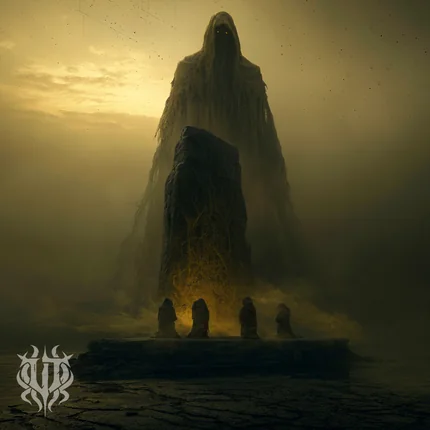
The King In Yellow is a dark metal journey into Carcosa, where Hastur’s influence spreads through dreams, madness and the cursed symbol that can never be forgotten.
References
- Library of Congress — The King in Yellow, F. T. Neely, 1895
Bibliographic record and page scans; the original contents include In the Court of the Dragon.
- Robert W. Chambers — The King in Yellow, Standard Ebooks text
Public-domain transcription. Its contents omit In the Court of the Dragon; this wiki uses a separate verified text for that story.
- Robert W. Chambers — In the Court of the Dragon
Public-domain 1895 text, checked separately because the Project Gutenberg 8492 transcription omits this story.
- Robert W. Chambers — biographical reference
- Ambrose Bierce — Can Such Things Be?
Public-domain collection, including An Inhabitant of Carcosa, Haïta the Shepherd, The Damned Thing and Moxon’s Master.
- Supernatural Horror in Literature — original essay
- The Whisperer in Darkness — original text
The fictional narrative is evidence for what the story says, not proof of events in the real world.
At a glance
Robert W. Chambers
1895
F. T. Neely, New York
Ten items, including the multi-part The Prophets’ Paradise
The first four stories
The 1902 Harper edition omits In the Court of the Dragon
No