

The Yellow Sign (story)
The Yellow Sign follows a New York painter and his model as disturbing dreams, a repellent church watchman and a mysterious clasp converge with the forbidden play The King in Yellow. Its first-person narrative makes artistic work and an unequal romantic attachment the setting for an intrusion that neither skepticism nor locked doors can contain.
6 min read · 1,190 words
Place in the collection
The Yellow Sign appears in Chambers’s The King in Yellow, published in 1895. In the original contents it follows In the Court of the Dragon and is the fourth story. Some later transcriptions omit that preceding tale, making its apparent position different.
The narrator is addressed as Mr. Scott. The Mask identifies a painter called Jack Scott within its circle of artists, providing a connection within the collection. The present story also refers to the tragedy of young Castaigne, recalling The Repairer of Reputations. These links give the forbidden play consequences across several personal histories.
The setting is a studio overlooking Washington Square in New York. Everyday details—models, newspapers, meals, costume, cigarette smoke and the sound of a neighboring church—provide the environment into which the increasingly intolerable presence enters.
Sources: Library of Congress — The King in Yellow, F. T. Neely, 1895, Robert W. Chambers — The King in Yellow, Standard Ebooks text
The watchman and the corrupted painting
Scott first notices the watchman without much interest. A clearer look at his face produces involuntary disgust, associated with the softness and pallor of a grave-dwelling creature. Returning to his easel, Scott finds himself unable to preserve the healthy flesh tones of his study of Tessie.
Attempts to scrape and clean the painting make its sickly appearance spread. He blames materials or his vision before destroying the canvas in frustration. Tessie herself remains healthy. The mismatch separates the model’s living body from the disturbing image that now seems impossible to correct.
The sequence does not simply present a finished magical portrait. It turns ordinary artistic labor into a failed attempt to maintain control over representation. Scott’s own practical explanations keep the first disturbance close to the familiar frustrations of painting, while its timing ties it to the watchman.
Sources: Robert W. Chambers — The King in Yellow, Standard Ebooks text
The shared hearse dreams
Tessie describes repeated dreams in which a hearse passes beneath her window. Its driver turns toward her, and she knows that Scott is in the coffin although she cannot see him. On waking she has found herself at the open window, once soaked by rain. Recognizing the church watchman as the driver terrifies her.
Scott initially proposes fatigue and disturbed sleep as explanations. He later dreams the complementary experience: confined in a glass-covered coffin, he sees Tessie looking down from her window. The driver eventually peers into the coffin. His attempt to describe this as the influence of her story on his imagination fails to reassure her.
The dreams bind their perspectives together before either understands the sign. They also give the later sound of approaching wheels a history. When the hearse finally arrives outside Scott’s building, it repeats something both characters have already experienced in different forms.
Sources: Robert W. Chambers — The King in Yellow, Standard Ebooks text
A witness outside the pair
Thomas, the building’s bellboy, recounts his own encounter with the watchman. Angered by the man’s stare, he struck him and then fled in disgust. During the struggle, a finger came off in his hand. Scott subsequently sees that the watchman’s right middle finger is missing.
This evidence does not come from Tessie’s dream or Scott’s painting. A separate witness reports a bodily anomaly, and Scott observes a corresponding absence. The story builds its pressure by allowing different kinds of evidence to converge without producing an ordinary explanation.
Scott also hears the watchman ask whether he has found the Yellow Sign. The phrase becomes clear to him only after its sound has troubled him repeatedly. At this point he has neither recognized the emblem nor read the play, so the question functions as an unexplained claim on his attention.
Sources: Robert W. Chambers — The King in Yellow, Standard Ebooks text
Attachment, responsibility and the gift
Tessie confesses that her fear is for Scott because she loves him. His impulsive kiss commits him to a relationship he had not intended. He reflects on his continuing attachment to Sylvia, on his own conduct and on the futures he imagines for Tessie. His account of caring for her coexists with condescension and assumptions about their unequal suitability for marriage.
The change affects their working relationship. Tessie becomes unwilling to pose nude as before, and Scott starts a costumed study. He gives her a gold chain and cross. In return she presents the black onyx clasp she found near the Battery and never succeeded in returning to an owner.
The gift is an expression of affection before it is an identified supernatural object. This gives Scott’s later inability to discard it a personal context, although he never settles on an explanation for that inability. The narrative makes the relationship part of the horror’s development rather than merely placing two interchangeable victims in a studio.
Sources: Robert W. Chambers — The King in Yellow, Standard Ebooks text
The book in the library
After a fall injures both wrists and prevents painting, Scott notices an unfamiliar volume on a high shelf. Its serpent-skin binding and pale lettering conceal a book he has deliberately avoided: The King in Yellow. He does not know how it entered his library.
Tessie takes it despite his warning and hides to read. He finds her after a search, silent and changed, with the book open at its second part. He brings her to the studio, then returns for the volume and reads it from beginning to end himself.
Their conversation changes. They discuss the King, the Pallid Mask, Hastur, Cassilda, Hali and the Hyades as if the work has given them a shared understanding that ordinary language cannot comfortably convey. Tessie now recognizes the mark on the clasp and asks Scott to throw it away. He wants to comply but cannot explain why he refuses.
Sources: Robert W. Chambers — The King in Yellow, Standard Ebooks text
The final visitation
Late at night, the sound of wheels approaches through the fog. Scott sees the black-plumed hearse and bolts the door. The visitor comes along the hall; the bolts decay under his touch. Within the darkness Scott cannot see the attacker clearly before feeling his cold grip.
The watchman takes the clasp and strikes him. Tessie cries out and dies. Scott experiences the catastrophe as the opening of the King’s tattered mantle, but the prose does not describe a definite body beneath it.
Other residents arrive to find one survivor and two dead bodies. The watchman’s corpse is so decomposed that the doctor concludes he must have been dead for months. Scott writes while dying, with a priest and physician nearby. He withholds further explanation and breaks off before offering the complete account that outsiders might demand.
Sources: Robert W. Chambers — The King in Yellow, Standard Ebooks text
Art, faith and incomplete explanation
The painter’s Catholic identity and the exchange of a cross matter to his understanding of consolation and duty. The neighboring church initially irritates him through noise and bad performance, yet its watchman becomes the bearer of something much more disturbing than aesthetic annoyance. Sacred surroundings do not prevent the intrusion.
Chambers moves from visual corruption to dreams, testimony, reading and bodily contact. Each stage narrows the characters’ room for dismissing what is happening. The ending supplies an impossible corpse while leaving the larger meaning withheld.
The visitor is not explicitly named Hastur, and the story does not provide a genealogy for him. His relation to the King is conveyed through Scott’s experience, the play and the sign. The absence of a complete explanation is a deliberate feature of the narrative’s final form.
Sources: Robert W. Chambers — The King in Yellow, Standard Ebooks text
Related music
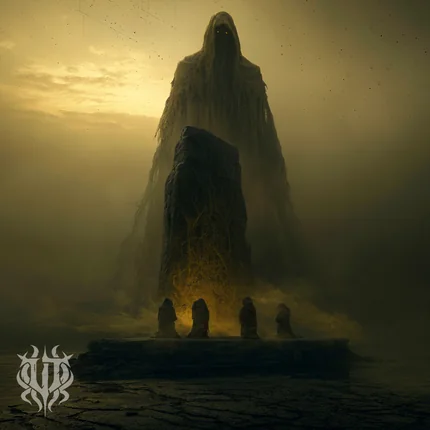
The King In Yellow is a dark metal journey into Carcosa, where Hastur’s influence spreads through dreams, madness and the cursed symbol that can never be forgotten.
References
- Library of Congress — The King in Yellow, F. T. Neely, 1895
Bibliographic record and page scans; the original contents include In the Court of the Dragon.
- Robert W. Chambers — The King in Yellow, Standard Ebooks text
Public-domain transcription. Its contents omit In the Court of the Dragon; this wiki uses a separate verified text for that story.
At a glance
Robert W. Chambers
The King in Yellow, 1895
Fourth story
Mr. Scott
Tessie Reardon
Washington Square, New York
Black onyx clasp inlaid with the Yellow Sign