

Hastur
Hastur begins as a god of shepherds in Ambrose Bierce’s Haïta the Shepherd. Robert W. Chambers reuses the name among the suggestive references surrounding The King in Yellow, and Lovecraft includes it in The Whisperer in Darkness. These appearances are stages of a literary history, not a single original description of a clearly defined monster.
6 min read · 1,131 words

The god who listens to Haïta
In Bierce’s pastoral fable, Haïta begins his days by praying at Hastur’s shrine before taking his sheep to pasture. The narrator explicitly identifies Hastur as the god of shepherds and says that the prayers please him. His favor belongs to the ordinary pattern of the young shepherd’s life, together with food, music, the flock and the hidden divinities of the countryside.
Sources: [1]
Haïta’s religious concern extends beyond his own safety. During floods he thanks Hastur for giving him nearby high ground but also demands protection for the people in distant cities. He threatens to withhold worship if they are abandoned. The narration says that Hastur, knowing the young man will keep his word, spares the cities and diverts the waters into the sea.
This episode presents the god as responsive to a moral demand. It gives no support to a description of Bierce’s Hastur as a tentacled enemy of humanity. The text does not show his bodily appearance at all; it specifically notes that he does not reveal himself to Haïta.
Hastur within a fable about happiness
The central difficulty of Haïta the Shepherd is the young man’s desire to understand his origin, duties and eventual death. Questions unsettle a life that had previously seemed sufficient. A radiant maiden then appears when he turns back toward duty rather than dwelling on unanswered problems.
She repeatedly leaves when he asks for certainty, imposes conditions or tries to secure her permanently. His care for his flock and an elderly hermit brings renewed encounters, but no lasting possession. The hermit finally names the visitor as Happiness and explains the impossibility of meeting her demands for long.
Hastur remains part of the story’s moral and pastoral environment. The maiden refers to the shepherd’s religious duties, but she is not identified as Hastur’s avatar. Neither the King in Yellow nor Carcosa appears. The story’s ironic conclusion concerns the briefness of happiness, rather than a secret revelation that its helpful god was a cosmic predator.
Sources: [1]
Chambers’s deliberately incomplete references
The Repairer of Reputations places Hastur beside Carcosa, Aldebaran and the Hyades in Mr. Wilde’s manuscript. Later passages mention lakes connecting these names, a son of Hastur and Hildred’s claimed right in Hastur. The vocabulary implies relationships without consistently explaining whether a given occurrence names a person, place, lineage or larger power.
The Mask includes Hastur among names passing through Alec’s fevered vision. In The Yellow Sign, Scott and Tessie discuss Hastur and Cassilda after reading the forbidden play. These are not extended appearances in which a narrator observes a creature’s anatomy or a god delivers a complete account of his nature.
Chambers’s use therefore supports a connection between the name and the play’s imaginative world. It does not supply a stable species description, a complete genealogy or an unambiguous equation of Hastur with the King. A careful encyclopedia can preserve the name’s recurrence without resolving every ambiguity on the author’s behalf.
Sources: [2]
A falconer named Hastur
The Demoiselle d’Ys uses Hastur as the name of one of Jeanne’s falconers. He belongs to the small household encountered by the traveler Philip, alongside servants with other names. Jeanne praises his ability, and a later scene places a trained bird on his wrist.
The story does not reveal him as a disguised deity. This is an explicit personal use of the name within Chambers’s collection, alongside the less clearly defined occurrences around the forbidden play. Treating every occurrence as a reference to the same cosmic individual would replace the story’s stated role with an unsupported identification.
Sources: [2]
The name in Lovecraft
The Whisperer in Darkness includes Hastur in the alarming accumulation of names that Albert Wilmarth encounters through Henry Akeley’s correspondence and associated evidence. The list also includes Lake Hali and the Yellow Sign. Their presence brings recognizable references from Chambers’s work into the same atmosphere as Lovecraft’s other occult names.
A further reference speaks of a secretive group connected with Hastur and the Yellow Sign that opposes the outer beings. This is information transmitted within Akeley’s account, not an independently narrated history of a cosmic war. It should be attributed to that account and its changing circumstances.
Lovecraft does not provide a bodily description of Hastur in this story. The passage cannot support adding wings, tentacles, robes or a planetary prison to his original text. The fact that a name occurs is secure; a much fuller portrait may belong to a later author or adaptation.
Sources: [3]
Lovecraft’s critical interpretation of Chambers
Supernatural Horror in Literature describes the talisman in The Yellow Sign as coming from a cult of Hastur and links it with primordial Carcosa. This is useful evidence of how Lovecraft read and retold Chambers. The original story itself gives the clasp’s discovery, its recognition after reading and the watchman’s retrieval without narrating that complete cult history.
The distinction matters when comparing the essay with The Whisperer in Darkness, where a group associated with Hastur and the Yellow Sign is explicitly mentioned. A critical paraphrase can help develop a later writer’s imaginative connections, but it should remain attributed to that writer instead of being inserted into the earlier fiction as if it were a missing sentence.
Sources: [4]
Later identifications and why credits matter
Later Mythos writing gives Hastur more definite roles, particularly through Derleth’s organization of the pantheon. The familiar association of Hastur with air and opposition to Cthulhu belongs to that later development. Treatments that identify the King in Yellow as Hastur or as one of his manifestations likewise need to name the version being discussed.
These extensions are part of the tradition’s history, but they should not overwrite the earlier texts. A statement true within a game setting may coexist with a different account in fiction. Neither automatically changes the shepherd god in Bierce’s fable.
Sources: [5]
A practical reading sequence
Begin with Haïta the Shepherd to see the original god in the context of the fable. Read the opening stories of The King in Yellow next, noting the actual words around each occurrence of the name. The Whisperer in Darkness then shows how a writer can borrow those references to make a new story’s background seem broader and older.
This sequence separates three different acts: creating a figure, reusing a name and incorporating an allusion into a new network. It also explains why a single modern illustration cannot function as the definitive portrait for every stage. A pastoral shrine, an indistinct presence around Carcosa and an explicitly later monster design answer different textual descriptions.
Hastur is especially useful for understanding the Mythos as a developing literary practice. Its shared vocabulary does not imply that all writers began with the same rules. The differences are evidence of how the tradition grew.
Related music
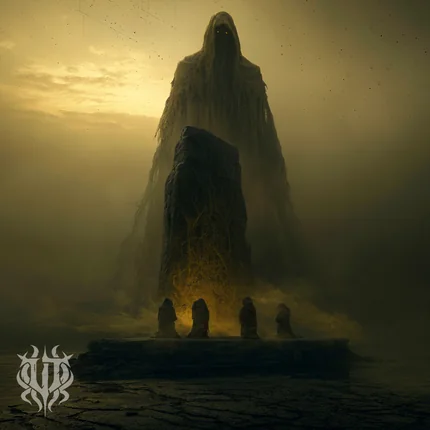
The King In Yellow is a dark metal journey into Carcosa, where Hastur’s influence spreads through dreams, madness and the cursed symbol that can never be forgotten.
References
- Ambrose Bierce — Can Such Things Be?
Public-domain collection, including An Inhabitant of Carcosa, Haïta the Shepherd, The Damned Thing and Moxon’s Master.
- Robert W. Chambers — The King in Yellow, Standard Ebooks text
Public-domain transcription. Its contents omit In the Court of the Dragon; this wiki uses a separate verified text for that story.
- The Whisperer in Darkness — original text
The fictional narrative is evidence for what the story says, not proof of events in the real world.
- Supernatural Horror in Literature — original essay
- Hastur — literary history
At a glance
Ambrose Bierce
God of shepherds in Haïta the Shepherd
Recurring name associated with the forbidden play
The Whisperer in Darkness
None in Haïta the Shepherd
Varies by author and adaptation